training.en.md 4.4 KB
Model Training
This page introduces how to train MiniMind language models from scratch.
📊 Data Preparation
1. Download Dataset
Download datasets from ModelScope or HuggingFace.
Create ./dataset directory and place data files:
./dataset/
├── pretrain_hq.jsonl (1.6GB, ✨Recommended)
├── sft_mini_512.jsonl (1.2GB, ✨Recommended)
├── sft_512.jsonl (7.5GB)
├── sft_1024.jsonl (5.6GB)
├── sft_2048.jsonl (9GB)
├── dpo.jsonl (909MB)
├── r1_mix_1024.jsonl (340MB)
└── lora_*.jsonl
!!! tip "Recommended Combination"
Fastest reproduction: `pretrain_hq.jsonl` + `sft_mini_512.jsonl`

**Single 3090 only needs 2 hours + $0.5!**
2. Data Format
Pretrain Data (pretrain_hq.jsonl):
{"text": "How to overcome procrastination? Overcoming procrastination is not easy..."}
SFT Data (sft_*.jsonl):
{
  "conversations": [
    {"role": "user", "content": "Hello"},
    {"role": "assistant", "content": "Hello!"}
  ]
}
🎯 Training Pipeline
All training scripts are located in the ./trainer directory.
1. Pretraining
The pretraining stage lets the model learn basic knowledge, the goal is to learn word continuation.
cd trainer
python train_pretrain.py

# Multi-GPU training
torchrun --nproc_per_node 2 train_pretrain.py
Output weights: ./out/pretrain_*.pth
!!! info "Training Duration"
- MiniMind2-Small (26M): ~1.1h (single 3090)
- MiniMind2 (104M): ~3.9h (single 3090)
2. Supervised Fine-Tuning (SFT)
The SFT stage teaches the model conversation patterns and adapts to chat templates.
python train_full_sft.py

# Multi-GPU training
torchrun --nproc_per_node 2 train_full_sft.py
Output weights: ./out/full_sft_*.pth
!!! info "Training Duration"
- MiniMind2-Small: ~1h (using sft_mini_512)
- MiniMind2: ~3.3h (using sft_mini_512)
3. LoRA Fine-tuning (Optional)
LoRA is a parameter-efficient fine-tuning method, suitable for domain adaptation.
python train_lora.py
Use Cases:
- Medical Q&A: use
lora_medical.jsonl - Self-awareness: use
lora_identity.jsonl
Output weights: ./out/lora/lora_*.pth
4. DPO Reinforcement Learning (Optional)
DPO is used to optimize model response quality to better align with human preferences.
python train_dpo.py
Output weights: ./out/rlhf_*.pth
5. Reasoning Model Distillation (Optional)
Distill reasoning capabilities from DeepSeek-R1.
python train_distill_reason.py
Output weights: ./out/reason_*.pth
📈 Model Architecture
MiniMind uses Transformer Decoder-Only architecture (similar to Llama3):
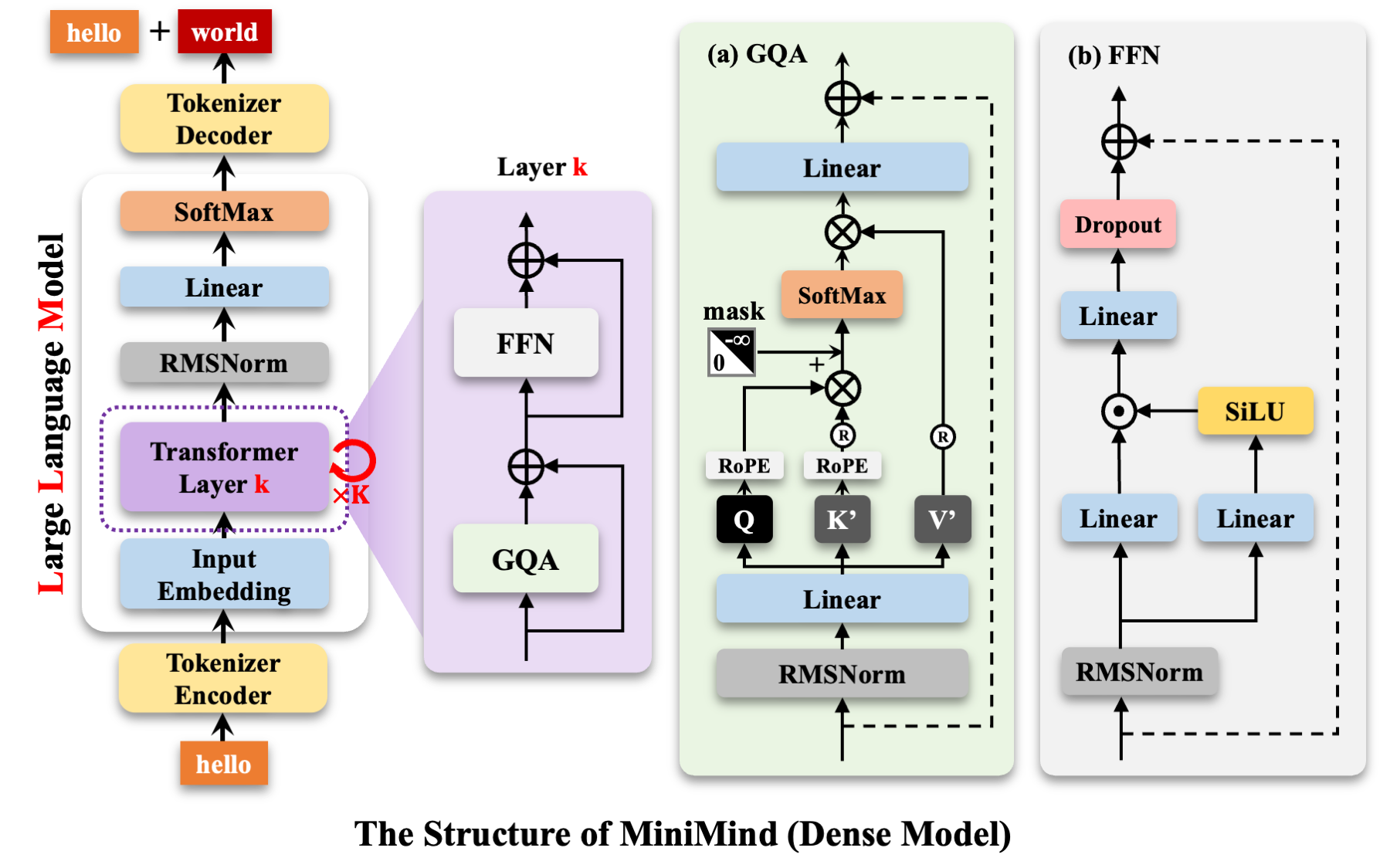
Model Parameter Configuration
| Model Name | params | d_model | n_layers | kv_heads | q_heads |
|---|---|---|---|---|---|
| MiniMind2-Small | 26M | 512 | 8 | 2 | 8 |
| MiniMind2-MoE | 145M | 640 | 8 | 2 | 8 |
| MiniMind2 | 104M | 768 | 16 | 2 | 8 |
🧪 Test Model
# model_mode: 0=pretrain, 1=sft, 2=rlhf, 3=reason
python eval_model.py --model_mode 1

# Test LoRA model
python eval_model.py --lora_name 'lora_medical' --model_mode 2
🔧 Multi-GPU Training
DDP Method
torchrun --nproc_per_node N train_xxx.py
DeepSpeed Method
deepspeed --master_port 29500 --num_gpus=N train_xxx.py
Wandb Monitoring
# Login first
wandb login

# Enable wandb
torchrun --nproc_per_node N train_xxx.py --use_wandb
💰 Training Cost
Based on single NVIDIA 3090:
| Dataset Combination | Duration | Cost | Effect |
|---|---|---|---|
| pretrain_hq + sft_mini_512 | 2.1h | ≈$0.35 | 😊😊 Basic chat |
| Full dataset (MiniMind2-Small) | 38h | ≈$6.50 | 😊😊😊😊😊😊 Complete capabilities |
| Full dataset (MiniMind2) | 122h | ≈$20.80 | 😊😊😊😊😊😊😊😊 Best performance |
!!! success "Quick Reproduction"
Using `pretrain_hq` + `sft_mini_512`, single 3090 only needs **2 hours + $0.5** to train a ChatBot!
📝 Common Issues
- Out of memory: Reduce
batch_sizeor use DeepSpeed - Training not converging: Adjust learning rate or check data quality
- Multi-GPU training error: Ensure all GPUs are visible and CUDA versions are consistent